What Is STILT?#
STILT (Stochastic Time-Inverted Lagrangian Transport) is a Lagrangian particle dispersion model for simulating atmospheric transport backward in time. It is used widely in atmospheric science to relate measurements of trace gases at a receptor location, for example a tower, aircraft, or satellite sounding, to the upstream surface areas that influenced that measurement.
PYSTILT is a pure-Python implementation of STILT built around the HYSPLIT Fortran binary. It brings the core transport model, the execution runtime, and a first observation layer into one modern, pip-installable Python package while working toward broader parity with the older R-based ecosystem.
The Science In Three Steps#
Define a receptor. This is a point in space and time representing where and when you made a measurement, or want to simulate one. In PYSTILT this is a
PointReceptor,ColumnReceptor, orMultiPointReceptor.Release and backward-track particles. An ensemble of theoretical air parcels is released from the receptor and followed backward through time using gridded meteorological wind fields. Random turbulent velocities are added to each particle. The result is a
Trajectoriesobject.Calculate the footprint. Particle positions and heights through time are converted into a gridded surface-influence function quantifying how strongly each upwind surface area influences the receptor. Footprints can then be convolved with a surface flux inventory to estimate concentration enhancements.
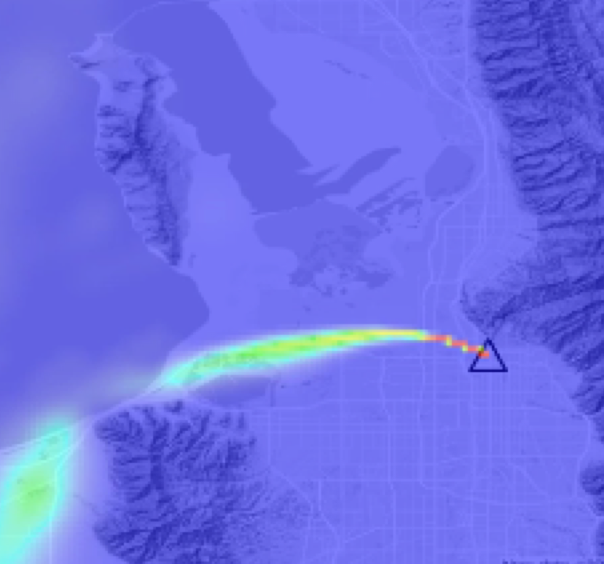
Surface-influence footprint for a receptor over Salt Lake City. Warm colors indicate strong upwind influence.#
The STILT / HYSPLIT Ecosystem#
PYSTILT sits at the top of a lineage of open-source atmospheric transport models:
Model |
Description |
Reference / Link |
|---|---|---|
HYSPLIT |
NOAA ARL’s hybrid single-particle Lagrangian integrated trajectory model. PYSTILT uses HYSPLIT to compute particle trajectories. |
|
STILT |
The core framework extending HYSPLIT with improved boundary-layer mixing, near-field dilution corrections, and footprint calculations. |
|
R-STILT v2 |
The redesigned R interface that shaped much of the modern STILT project layout and user workflow. |
|
X-STILT |
R-STILT extensions for column and satellite workflows, including averaging kernels and transport-error analyses. |
|
stiltctl |
Operational Python tooling for large STILT workloads on Kubernetes and cloud infrastructure. |
|
PYSTILT |
The current Python package aiming to unify transport, output runtime, and observation-facing workflows. |
Key Improvements Over R-STILT#
Pure Python. No R runtime is required.
Strong typing. Configuration is validated before runs start.
Flexible receptors. Point, column, slant, and multipoint workflows share the same receptor foundation.
Multiple execution backends. Local, Slurm, and Kubernetes are part of one execution model.
Resumable by key. Completion is read from the outputs on disk, so runs pick up exactly where they left off.
Standard outputs. Trajectories are stored as Parquet and footprints as NetCDF.